
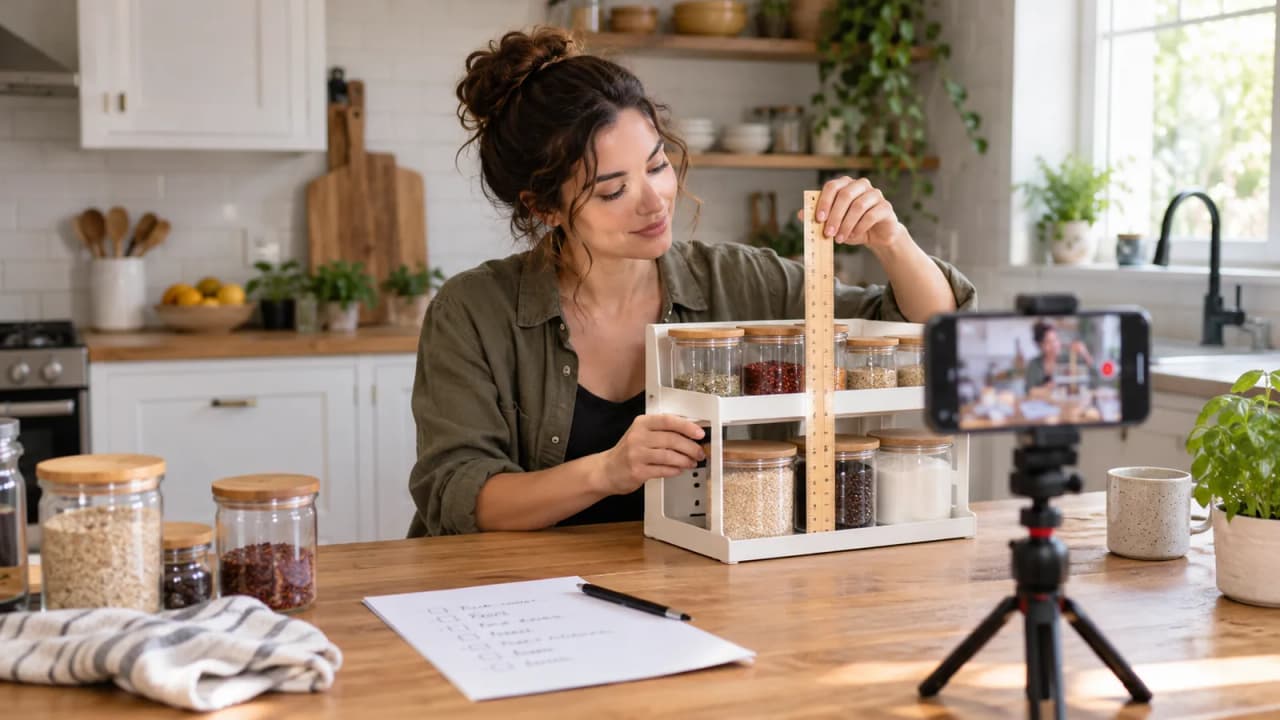
A kitchen organizer can look useful in a holiday montage and still leave a viewer with the wrong question answered. Does it fit beneath their shelf? Can they remove the back jar without emptying the front row? Those details deserve a demonstration before a discount graphic.
For TikTok Shop's 2026 holiday campaign, prepare a product-demo brief around visible evidence, a clearly described commercial relationship, and information that can be checked again before publishing. TikTok's October 14 holiday announcement sets its U.S. Black Friday and Cyber Monday campaign for November 11–30. That calendar gives creators a planning window; it does not establish an offer for a particular product or predict a creator's sales.
Here is a filled fictional brief for Mara's imaginary kitchen channel, Small Counter. The organizer, measurements, seller response, and decisions are invented to illustrate the method. They are not a tested product, a current listing, or a buying recommendation.
| Viewer question | Fictional evidence to capture | Approved wording or decision |
|---|---|---|
| Will it fit? | Ruler beside the sample: 22 cm wide, 15 cm deep, 25 cm tall | State these sample dimensions; ask viewers to measure their own space |
| What can I reach? | One continuous shot removing a back-row jar | Describe only the jars and arrangement actually shown |
| What does not fit? | Taller jar touches the shelf above | Show the limitation before the final product view |
| Is the offer current? | Seller confirms exact variant and current listing | Recheck on publication day; omit an unconfirmed sale price |
| Is this commercial? | Mara has an agreed paid demonstration | Use the applicable commercial disclosure and say who supplied the sample |
| What changes later? | Stock, price, variant, or offer terms change | Review the caption and linked listing; correct outdated claims |
Start with a question the camera can answer
Write the viewer's practical question at the top of the shot list. “Can I reach the back jar in this cupboard?” is specific enough to film. “Will this transform my kitchen?” invites an answer the footage cannot establish.
Mara starts with the cupboard as it is, including the awkward corner. She keeps the camera position fixed while adding the organizer. The comparison helps a viewer understand the layout without implying that every kitchen has the same dimensions.
Choose one main question per video. Save a separate question, such as cleaning or assembly, for another complete demonstration if you can show it accurately. A short video is more useful when its promise matches the evidence it contains.
Build a proof shot before a beauty shot
Capture the measurement with the ruler in the same plane as the relevant edge. Record which product variant is on the table. If the seller's listing and the sample disagree, resolve that difference before describing the dimensions as a verified product specification.
Next, show the action from start to finish. Mara removes the back jar without cutting away, then repeats the movement with the taller jar that causes a problem. The limitation belongs in the edit because it affects the viewer's decision.
Do not replace a missing observation with generated footage, an attractive mockup, or a claim copied from a different variant. If a demonstration requires a condition you cannot reproduce, narrow the promise to what you can actually show.
Separate the product demonstration from the offer
A sample can stay the same while its price, bundle, or availability changes. Keep two records: one for what was demonstrated, and one for the current offer. The demonstration record contains the variant, footage filenames, measurements, and limitations. The offer record contains the listing URL, terms checked, date, and confirmation owner.
TikTok's holiday announcement describes delivery badges on eligible products. It does not make every product eligible or establish an arrival date for an individual order. Do not place a platform-wide delivery promise over a sample merely because it appears in holiday coverage.
When the seller has not confirmed the offer, finish the useful demonstration without an invented price or countdown. A factual evergreen clip is easier to maintain than a promotion built around an assumption.
Make the commercial relationship understandable
TikTok's commercial-content help says promotional posts must use its content disclosure setting. It distinguishes promotion of your own business from branded content for another business. Select the current option that matches the actual relationship in your account.
For the fictional Small Counter brief, Mara also plans a plain spoken statement that the demonstration is paid and that the seller supplied the sample. The wording should describe the real arrangement rather than imply an independent purchase that did not happen.
Keep disclosure review separate from approving the script's product claims. A commercial label does not verify dimensions, demonstrate durability, or make an unsupported comparison accurate. Both the relationship and the demonstration need their own clear evidence.
Reserve a publication check on the calendar
Work backward from the intended posting date. Mara needs a confirmed sample, time to capture the proof shots, a factual review, and a final listing check. These are dependencies, not four tasks that can all happen after the edit is finished.
In a small team, write one owner beside each dependency. “Seller confirms variant” and “creator checks the public listing” are different responsibilities. If the sample arrives late, move the publication date or reduce the scope; do not quietly borrow footage of another version.
The November 11–30 campaign dates provide context for this plan. Access to affiliate features, products, offers, and platform programs remains account- and market-dependent. Check the account and seller details you actually have before promising a campaign deliverable.
Leave room for the answer you did not expect
The most useful part of a demonstration may be a mismatch. A jar may be too tall. A drawer may fail to close. An organizer may work on the open counter but not under a cupboard. Keep those observations in the review notes even when they complicate the planned hook.
Mara's review decision is to show the taller jar catching the shelf, then explain the clearance a viewer would need to measure. She does not call the organizer unsuitable for everyone or conceal the limitation behind a faster edit.
After publication, save substantive viewer questions for the next review. A question about a different cupboard size is a new demonstration request, not permission to guess that the sample will fit. Answer from the available evidence or state what you have not tested.
Save a handoff that can survive an offer change
Keep the approved script, original proof footage, product variant, listing check, disclosure decision, and correction owner together. Before reusing the clip, check the offer again. If the old claim is no longer accurate, revise the reusable version and explain any material correction where the original was published.
For the next filming session, complete one brief for one product and capture its hardest proof shot first. Use the o1 guides to explore the product's direction, and consult the current o1 specifications and boundaries and o1 AI workspace before assigning it a role. The physical o1 device remains in development; this article does not establish TikTok account access, product testing, posting, or seller verification through o1.
The deliverable is a reviewable demonstration with a current offer record. Its usefulness comes from answering the viewer's question accurately, without promising a particular reach, conversion rate, or holiday income.