
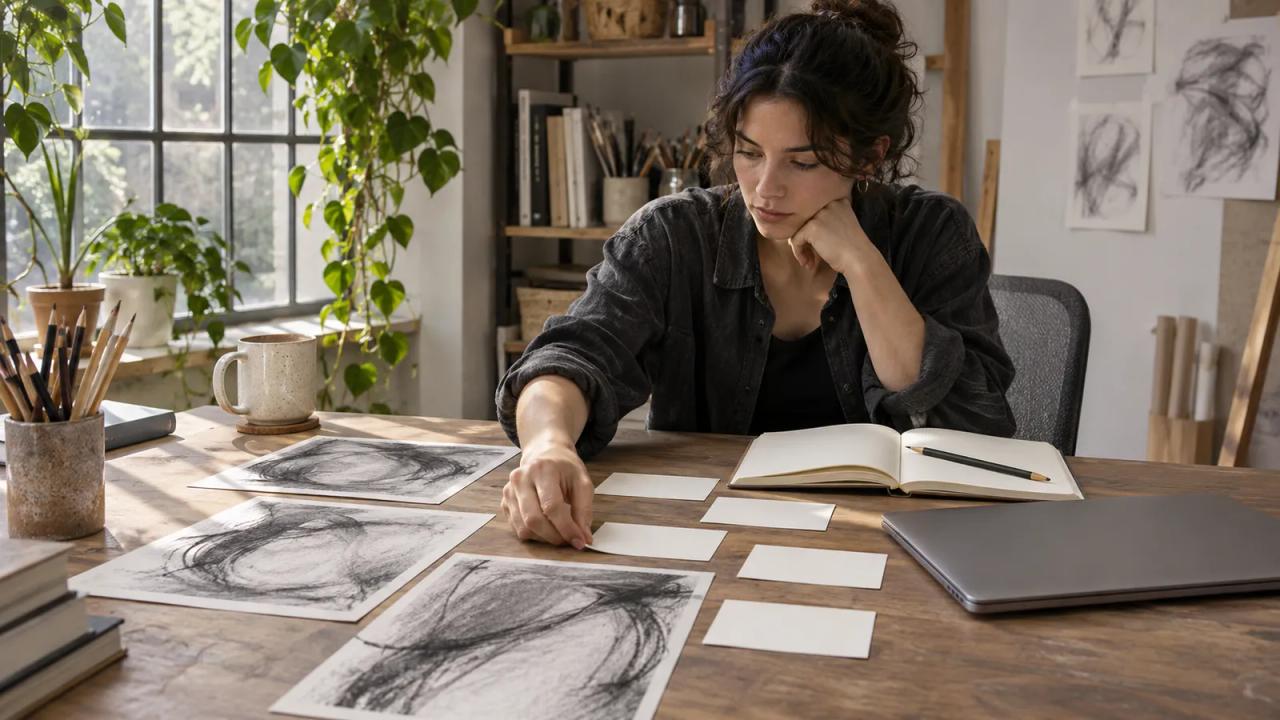
Prepare one art question by separating what you can see, what a curator says, and what you infer. That gives a museum livestream comment a clear purpose and leaves you with notes you can use without presenting your interpretation as an institutional explanation.
Rae, the fictional host of Looking Again, wants to watch the announced Lucas Museum TikTok LIVE and later make an original reflection. She starts with her own invented study picture of a person passing a lantern to another figure. This filled ledger illustrates preparation; it describes no museum artwork, completed broadcast, or curator answer.
| Ledger field | Filled fictional preparation | Boundary to preserve |
|---|---|---|
| Visible detail | One figure holds a lantern near the other figure's hand | This is Rae's invented practice picture |
| Initial interpretation | The gesture might suggest responsibility being passed on | A possibility, not an established meaning |
| Question to ask | What visual detail would help distinguish help from a transfer of responsibility? | One focused question about how to look |
| Curator evidence | Wait for a named speaker's actual explanation during the real LIVE | Do not invent an answer in advance |
| Follow-up output | An original spoken reflection using Rae's own study material | No assumed permission to reuse broadcast footage |
| Review decision | Preserve speaker attribution and mark remaining uncertainty | Observation, source statement, and inference stay distinct |
TikTok's November 3 event announcement schedules The Art of Heroes for November 9, from 5:30–8:15 p.m. PT. The official announcement still lists that schedule when checked on November 9. This event-day guide prepares a viewing method before the announced broadcast; it reports no attendance, completed interview, or available replay.
Know which event you are preparing for
The announced schedule has three parts: Who Are Our Heroes? from 5:30–6:30 p.m. PT, The Hero's Journey from 6:30–7:30 p.m. PT, and The Hero's Legacy from 7:30–8:15 p.m. PT. TikTok lists @lucasmuseum, @tiktok, and @tiktoklive_us as streaming accounts, with @starwars also co-streaming the final segment. These are announced plans, rather than a report of what aired.
Use the dated official announcement to check the current schedule and entry point before the event. Keep the published time zone attached to any calendar note. A time shown in PT is not automatically the local time of every viewer.
Do not build your production plan around an assumed replay. Nor does an invitation to watch establish permission to download the broadcast, rebroadcast it, or use museum images in a separate video. Rae's proposed output can use her own practice picture while discussing what she learned about looking.
Choose a question that starts with a visible detail
An open comment such as “What does art mean?” leaves almost every decision to the speaker. A question anchored to a gesture, arrangement, contrast, or repeated object gives the conversation a smaller place to begin.
The museum's description of its purpose places narrative art within the stories people tell through images. Use that as context for looking at relationships within an image, rather than treating a familiar character name as a complete analysis.
Rae's lantern exercise identifies a visible action before proposing a meaning. She can revise the question if the real broadcast presents different material. Preparing a method should make her more attentive to the event, not determined to force the event into a sentence written earlier.
Keep three kinds of notes apart
Give each note a plain label: visible observation, speaker statement, or personal interpretation. The labels need not become a complicated database. Their job is to prevent a fluent recap from blending different kinds of support into one confident claim.
An observation records what you could actually make out. If a detail was obscured by the camera angle or too small on your screen, keep that limit. A speaker statement needs the person's name or role and enough context to understand what they were discussing.
An interpretation records your own reasoning. It can be useful even when it remains uncertain. Write what led you to it and what might change it. “I read this gesture as a handoff” is a different claim from saying that the curator identified the scene that way.
Ask one question and listen for its scope
Before posting, remove the biography, sales pitch, or second question that obscures the first. Make it possible for a host to understand the actual observation and respond without guessing what you wanted.
If the speaker answers a nearby question, record the answer they gave. Do not reshape it into a response to your preferred wording. Audience comments may move quickly, and an announced opportunity to ask questions does not guarantee that your own comment will be selected.
Treat a general explanation as general. A speaker discussing narrative techniques across several works has not necessarily supplied a definitive meaning for the particular image you had in mind. Leave a follow-up question in the ledger when the connection remains unresolved.
Make a reflection from notes you can support
After watching, choose one thing your understanding changed about. Rae's proposed reflection might compare her initial lantern interpretation with a different way of examining the figures' relationship. It should identify which part came from the broadcast and which part remains her own exercise.
Check any direct quotation against a reliable record before using quotation marks. If you cannot verify the exact words, write a clearly attributed paraphrase only as far as your notes support it. Remove an attractive sentence whose source you cannot recover.
Plan the visuals independently. Your own sketches, authorized photographs, or original study material can explain your thinking without pretending to reproduce the museum experience. Describe the actual material you used, and check any additional asset permissions for that particular publication.
Leave the viewer with a way to look again
Review the exported reflection for attribution, legible context, and an understandable distinction between seeing and interpreting. A short clip should still make sense when someone encounters it without the full event announcement.
For adapting the written planning process, consult the o1 guides, current specifications, and o1 AI workspace. The physical o1 device remains in development. This article establishes no museum access, livestream capture, artwork license, or automatic source verification through o1.
Pick one image you are authorized to study today. Record a visible detail, propose one interpretation, and write the question that would help you examine the difference.