
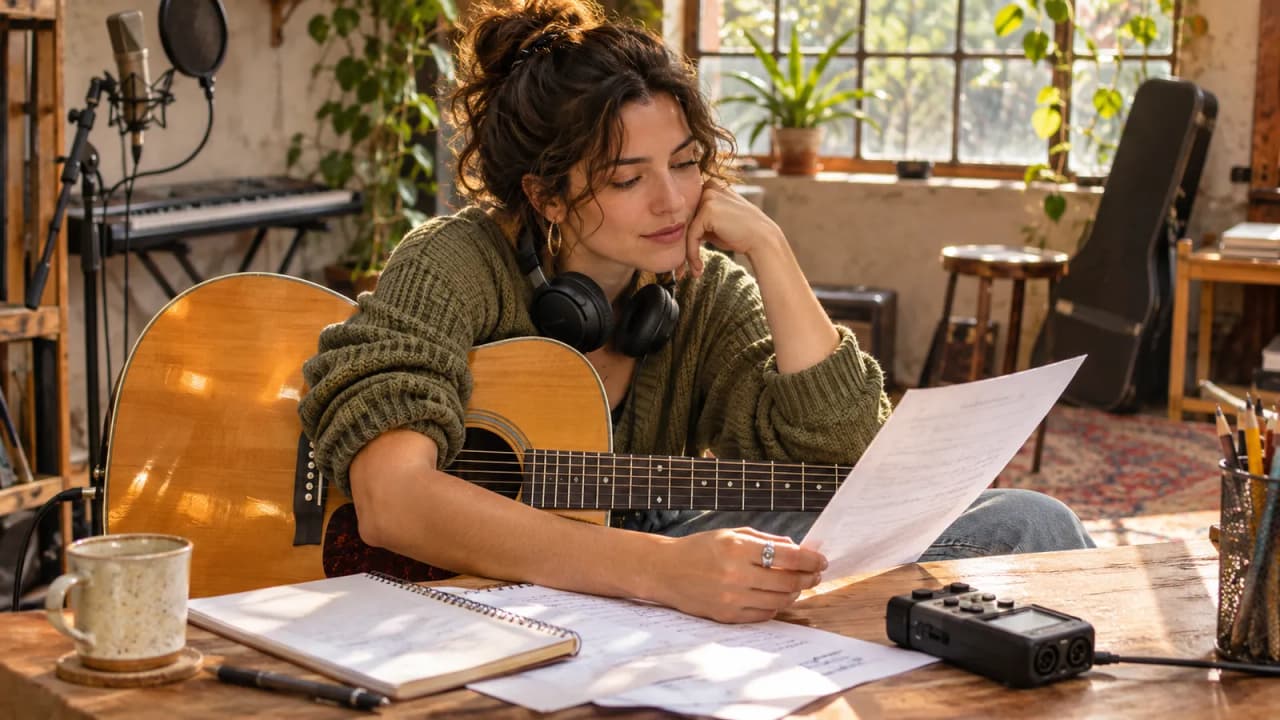
Prepare a song feedback brief with one version, one listening question, and one decision you can make afterward. A useful response tells you what the listener heard and where; a broad request to judge an entire career gives them little to work with.
Spotify's November 2 Fresh Finds Summit announcement describes a gathering in Los Angeles on November 4 and 5, including song feedback and practical sessions for artists from Fresh Finds Forward. This guide uses that current event as a reason to prepare a focused brief, without claiming attendance or access.
Jun, the fictional independent artist in this example, wants to understand whether the first chorus of a new demo feels like an arrival. The following invented card could support a conversation with an authorized reviewer or a trusted collaborator. It is not a submission form or a Spotify selection result.
| Brief field | Filled fictional example | What the reviewer needs |
|---|---|---|
| Version | Window Light demo r07 | One stable audio file with the same version name |
| Listening passage | 00:20 to 01:05 | Enough lead-in to hear the first chorus arrive |
| Main question | Does the first chorus feel distinct from the verse? | A response tied to an audible moment |
| Keep constant | Lead vocal take and current lyrics | Avoid reopening every creative decision at once |
| Useful feedback | What changed in energy, and where did attention move? | Observations before proposed fixes |
| Next decision | Try one transition edit, then compare with r07 | Preserve the original for the comparison |
Separate the event news from your actual access
The Summit announcement concerns artists in Fresh Finds Forward. Spotify says hundreds will attend in person and that sessions will be filmed for artists in the program. It does not establish a public walk-in event or a universal public stream.
Check your own invitation, account information, and permitted materials if you are participating. Do not book a production around assumed access or describe a program recording as something everyone can view.
Spotify's September 17 program introduction explains invitations through Spotify for Artists for eligible artists added to Fresh Finds playlists from January 1, 2026 onward. Keep that dated program description distinct from a promise that any particular artist will be selected.
Jun needs no attendance claim to use a better feedback brief. He can prepare the same clear question for a collaborator who has agreed to listen.
Choose the decision before choosing the excerpt
Write the decision you need to make, then choose the passage that lets someone judge it. For Jun, a chorus-only clip would hide the transition he wants reviewed. He includes part of the verse and the moment the chorus begins.
A different question needs a different excerpt. A lyric clarity question might need the complete line and its surrounding phrase. An arrangement question might require a longer build. Select enough context to hear the problem without turning the brief into an unexplained folder of every recording.
Use an owned or appropriately authorized demo. Confirm what you are permitted to share, with whom, and for what purpose. An invitation to hear one recording does not automatically authorize publishing every response or circulating someone else's unreleased material.
Make one stable listening reference
Choose one file and give it a version name that also appears in the brief. If you replace that file, update the name or record the revision. Otherwise, a reviewer may describe a moment that no longer exists in the version you open later.
Check the excerpt yourself before sending it. Confirm its beginning and ending, that it plays normally, and that the relevant musical change is included. Keep timestamps relative to the same reference so the response is easy to locate.
Jun also writes one sentence of context: this is a demo, and the current question concerns the transition rather than the final mix. That tells the reviewer what kind of response would help without demanding agreement with a preferred answer.
Ask for observations before prescriptions
Start with what the listener noticed. Jun can ask where the energy changed, what drew attention at the chorus entrance, and whether any element obscured that change.
Record observations separately from suggestions. “The vocal feels smaller when the percussion enters” describes an experience. “Add another guitar” proposes one possible response. Keeping them distinct leaves Jun room to test a different solution.
Do not turn one person's reaction into a claim about the whole audience. Save who reviewed the file, the version they heard, and the context of the conversation. If they permit a private note but not a public quotation, keep the response private.
The useful outcome is a clearer decision, not a fabricated endorsement or a promise of playlist placement.
Test one response against the unchanged demo
Choose a small edit that answers the observation you understood. Jun might adjust the transition into the chorus while keeping the lead take and lyrics constant. He gives that revision a new name and retains r07.
Listen to both with the same question in view. Compare the relevant passage rather than declaring the new version better because it is newer. Write what still needs checking, including any change that improved one moment while weakening another.
A response can also lead to no edit. If the suggestion would undo the intended character of the song, Jun can preserve the recording and explain that choice in his notes. A feedback conversation supplies information; it does not transfer every creative decision to the listener.
Leave with an accountable next action
Save the version reference, question, permitted response notes, chosen experiment, and next listening time together. Keep a record of what remains unresolved so the next session begins with the actual decision rather than a vague memory of encouragement.
For related written planning patterns, see the o1 guides, current specifications, and o1 AI workspace. The physical o1 device remains in development. This article establishes no Spotify account connection, music submission, audio analysis, or Fresh Finds program access through o1.
Select one demo and one question today. Give a willing reviewer enough context to answer it, then make a small, reversible musical decision from the response you actually received.