
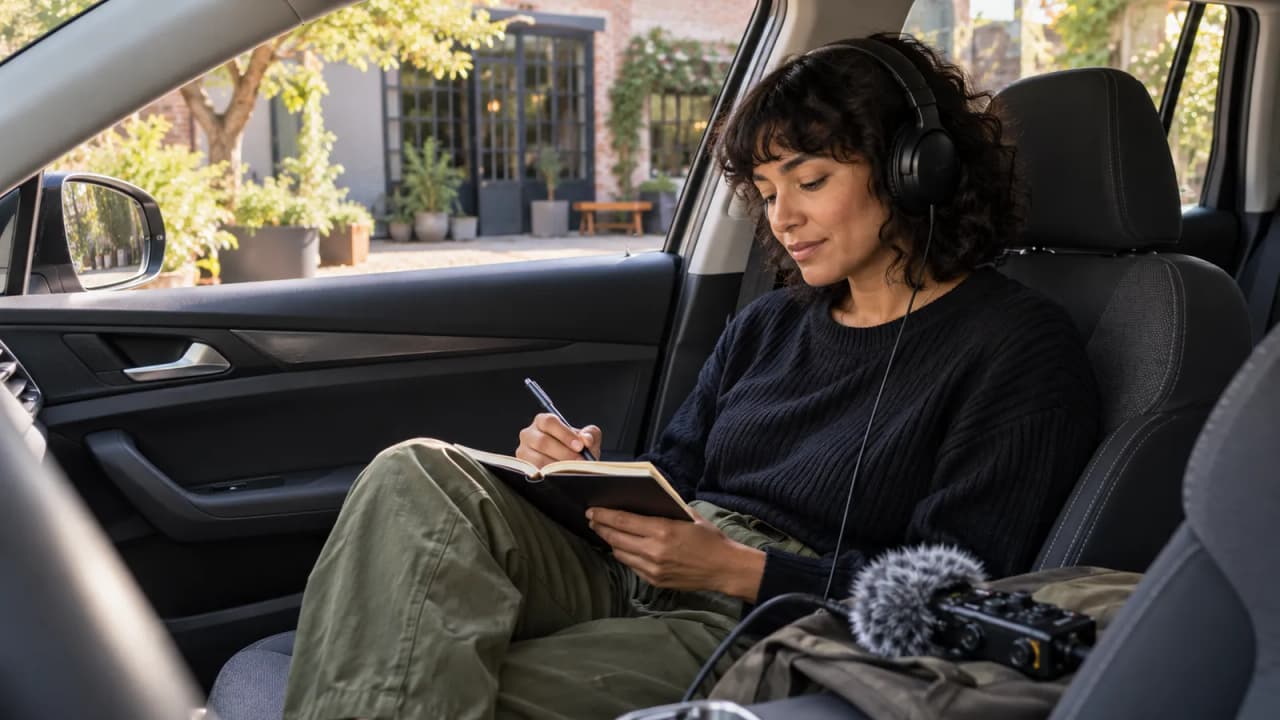
Review a video podcast once with the picture hidden before approving the episode. Identify every reference that depends on a chart, gesture, or on-screen name, then add only the spoken context needed to follow the conversation. A polished video should still make sense when someone is listening.
Spotify's October 21 Audi app announcement makes that distinction concrete: the center display restricts video and lyrics while moving, while parked use supports video. This November 3 guide turns that news into an editorial listening exercise. It is not a vehicle review or a report of a road test.
Mara, the fictional host of the design podcast Small Objects, has an interview about two reusable bottle lids. Her proposed review card looks like this:
| Episode moment | Filled fictional listening note | Proposed correction |
|---|---|---|
| Guest introduction | Guest's name appears only in a lower-third graphic | Say the name and relevant role aloud |
| First comparison | Host says “this one” while holding a lid | Name the screw-top lid before discussing it |
| Chart discussion | The important difference is visible but not spoken | Explain the compared measure in a short sentence |
| Demonstration | A silent close-up shows the hinge movement | Add a concise description of what changes |
| Closing | The resource address appears only on screen | Tell listeners where the episode notes are |
| Final check | Revised export has not been reviewed | Listen again to the actual release file |
Mara and the episode are invented. The card illustrates a production review, not evidence of listener growth, retention, or improved accessibility.
State what the car announcement actually changes
Spotify lists its native app for Free and Premium listeners in the A6 e-tron, Q6 e-tron, A5, Q5, and A6, with availability varying by vehicle and market. An Audi connect package may be required. The announcement places the Q7 and Q9 at their future market launch, rather than treating every model as supported now.
The creator decision is narrower: do not make understanding depend on a picture remaining visible. The announcement describes parked video use and supported passenger-display features, but those do not remove the need for a coherent audio track. Keep platform availability and the quality of your episode as separate questions.
Make the listening pass genuinely audio-first
Use a stationary review setup, such as headphones at a desk or a safely parked location. Hide the picture and read neither the transcript nor the episode notes during the first pass. Do not operate editing controls while driving.
Start with a fresh copy of the review card. Write the time of a confusing passage and the question it leaves unanswered. “Which lid is being discussed?” gives the editor a concrete correction. “Needs more energy” does not explain what a listener is missing.
Replace vague references with useful names
Mara's first edit replaces “this one is easier to clean” with a reference to the removable screw-top lid. That establishes the object without forcing the listener to remember which hand held it.
Look for phrases such as here, on the left, as you can see, and the blue section. They may work in the video while leaving the audio incomplete. Name the relevant object, position, or comparison when it matters to the point.
Avoid turning every scene into a detailed visual inventory. The listener needs the part that supports the conversation. For the lid demonstration, that may be the hinge opening fully for cleaning, not the color of the table or the guest's sleeve. Keep the description tied to the episode's actual question.
Give a chart one spoken conclusion and its limits
Before recording an extra sentence, identify what the chart can establish. In Mara's fictional example, a chart compares two cleaning steps in a demonstration. It does not establish universal durability or a laboratory result.
Write the measure, comparison, and limitation in plain language. If the underlying values are important, verify them against the source material and say them accurately. If a source cannot be checked, remove the unsupported claim rather than making the narration sound more certain.
Preserve enough context for someone joining midway through the episode. A short reminder of what is being compared can help more than reading every axis label. Keep detailed tables or links in the episode notes as supporting material, while ensuring the spoken point can stand on its own.
Check the edit against the picture again
After the audio-only pass, restore the video and inspect every change in context. A newly recorded explanation must agree with the object or chart on screen. Check that the cut has not moved a sentence over the wrong demonstration.
Spotify's video-podcast editing guide, originally dated April 21, 2022, emphasizes checking audio and video synchronization through an edit. Treat it as an evergreen production reference, not a new feature announcement.
Listen near each changed boundary as well as watching it. A sentence can be correct yet sound abruptly inserted, overlap a guest, or remove the pause that made the exchange understandable. Fix the specific transition and replay the surrounding passage before approving it.
Review the release file and the listener handoff
Export the intended episode and repeat the audio-first check on that file. An editor preview does not prove that the delivered track, sequence, or final closing line is correct.
Confirm that the guest introduction, important comparisons, and next action remain understandable. Open the episode notes and check the resources mentioned aloud. If the spoken instruction says a link is included, verify the actual published destination before relying on it.
Keep the review record descriptive. Mara could record that a particular unnamed-object reference was corrected and rechecked. She could not claim that this exercise increased completion rates or demonstrated how Spotify performs in a particular vehicle. This guide reports neither result.
Keep a repeatable episode card
Save the timestamped notes, proposed changes, approval decisions, and final export reference with the episode. Use the next review to find new gaps rather than copying the previous card's conclusions.
For adapting this written planning process, see the o1 guides, current specifications, and o1 AI workspace. The physical o1 device remains in development. This article establishes no Spotify connection, vehicle control, audio-file editing, or podcast distribution through o1.
Pick one finished segment today. Hide the picture, note the first missing reference, and make the smallest spoken correction that lets a listener follow the same idea.