
A Halloween trend becomes a useful video when you turn it into a question you can answer on camera. Start with the searcher's task, choose something you can demonstrate before the holiday, and keep the promise narrower than the trend headline.
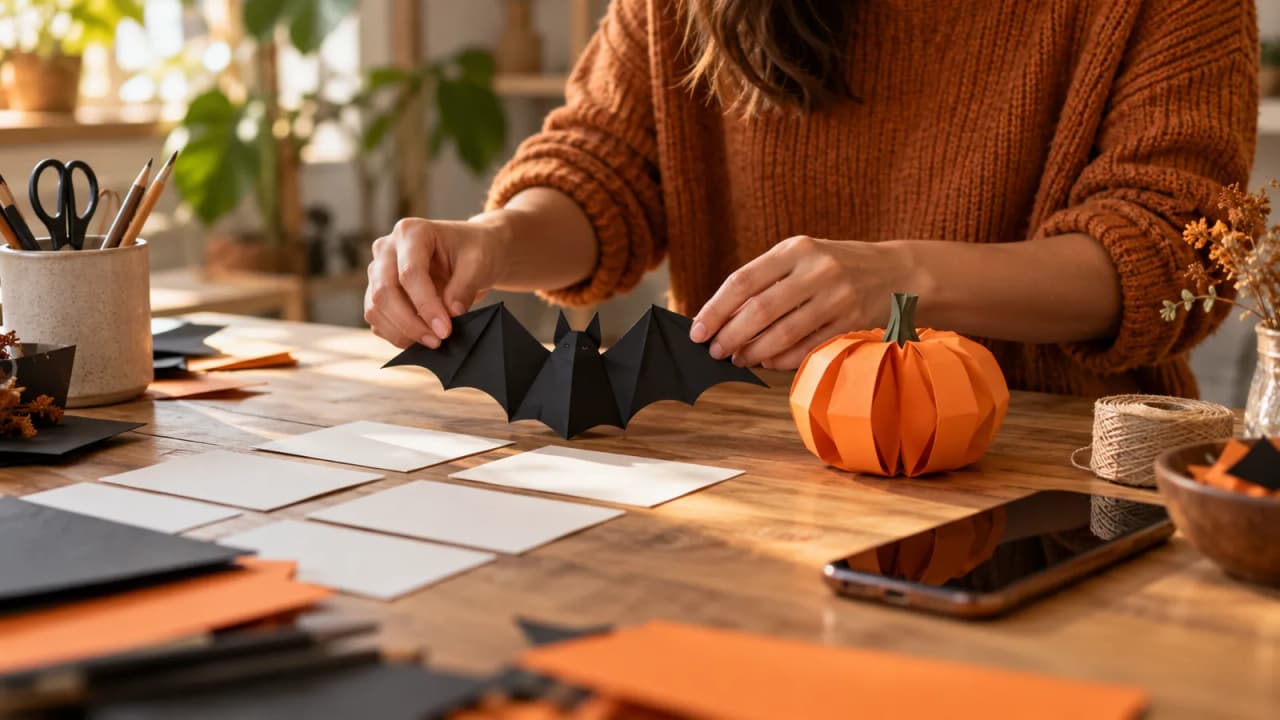
For this Halloween-weekend planning exercise, imagine Mara, the fictional creator of Paper Window, making a small paper backdrop for a desk video. She has an afternoon, leftover card, and a camera. She needs a filmable idea, not a claim that her channel has discovered the season's biggest trend.
| Intent card | Filled fictional example | Production check |
|---|---|---|
| Viewer task | Make a small Halloween backdrop from leftover card | Show the finished size beside an ordinary notebook |
| Question answered | How can I make a folded paper silhouette stand upright? | Film the fold and support clearly |
| Opening shot | Completed silhouette standing on the desk | Use the actual object made in the demonstration |
| Materials | Card offcuts, pencil, scissors, and removable tape | Name only materials actually used |
| Honest limit | One decorative example for this desk | No claim that the design suits every surface |
| Final asset | Short demonstration with material list and finished dimensions | Check the exported file against the card |
Mara and the planned project are invented. The table is an original editorial example, not a tested result, a trend ranking, or a recommendation from Google.
Use the seasonal source with its real date
Google published its Frightgeist 2026 announcement on October 14. It points to Halloween search interest across costumes, party ideas, effects, and viewing choices. The publication date matters: this is a seasonal source being consulted near Halloween, not a new announcement.
A useful response does not have to repeat the listed ideas. Mara's paper backdrop is her own adjacent production concept. She should never label it a top Frightgeist query unless she finds and records evidence supporting that exact statement.
Keep three separate lines in your notes: what the source reports, what you observed in a current check, and the idea you chose to make. That separation prevents an attractive brainstorm from quietly becoming a factual claim about demand.
Translate a topic into a viewer's unfinished task
“Halloween” is a subject, not a brief. A viewer might be choosing a costume, preparing a room, finding a film, or finishing a decoration. Those tasks need different videos and different evidence.
Mara chooses a small decoration because she can make and show the object herself. She leaves costume rankings and movie recommendations for creators with the relevant material. The useful question is whether her demonstration resolves something a viewer is trying to do.
Write the task as a sentence beginning with a verb: make, compare, choose, arrange, or repair. Then name the constraint. Leftover materials, a small desk, or a short preparation window can give the video a clear purpose without an unsupported claim about popularity.
Record the comparison before interpreting the chart
If you use Google Trends to examine an idea, save the terms, geography, time range, search type, and date of your check. Compare like with like. A chart for one country and a short holiday window should not become a statement about worldwide annual demand.
Google's Trends data FAQ explains that its figures show normalized relative interest rather than absolute search counts. A score of 100 is not 100 searches, and an interest spike does not establish what every viewer wants.
This article supplies no live chart measurement for Mara's idea. Before reporting one yourself, capture the actual settings and result. If you cannot repeat or explain the comparison, leave the number out and present the video as your own practical seasonal suggestion.
Choose a project you can finish honestly
The calendar changes the production decision. With Halloween close, a complicated build may leave no time to film instructions, correct an unclear step, or export a readable version. Choose a smaller result that you can show completely.
Mara's brief includes the support fold because that is the unresolved step. A montage of cutting and a finished backdrop would hide the answer. She plans a close shot of the fold, a side view of the base, and a final view beside a notebook.
Do a plain rehearsal before styling the set. If the object falls over, adjust the project and record what changed. Do not cut around a failed step and leave a title implying that the original method worked as shown. The recorded demonstration should support the instructions viewers receive.
Write the title after you know the result
A working title such as “A Folded Paper Halloween Backdrop for a Small Desk” describes Mara's object and use. It does not need “viral,” “guaranteed,” or a claim to be the most searched decoration. Choose wording that matches the completed film.
The description can list the actual materials, the finished dimensions, and the point at which the support fold is explained. Remove any detail that changed during filming. If the final object uses tape, the materials list should not still promise a tape-free method.
Check the thumbnail in the same way. Show the object the video makes, with enough context to understand its scale. A more elaborate generated decoration would make a different promise from the footage and give the viewer a reason to distrust the tutorial.
Keep the evidence attached to the edit
Give the editor the approved intent card, selected shots, material list, source notes, and any changed instructions. Mark a source fact separately from your production choice. A link to Frightgeist explains the seasonal research context; it does not validate the dimensions of a paper prop.
Watch the export without the planning notes. Can you see the support fold? Does the finished object match the opening? Are the measurements and material names readable on a phone? Correct the actual file that will be published.
Save the original version and a short change note. If a later caption shortens the instructions, review that version too. A complete tutorial can become misleading when its smallest but essential step disappears from the clip used to promote it.
Make one useful answer before adding more trends
Publish the piece you can support, then examine real audience questions before commissioning a series. A question about a larger backdrop might justify a separate project. It does not prove that the small version should have promised every size.
For adapting written creator planning in Growit, read the o1 guides, current specifications, and o1 AI information. The physical o1 device remains in development. This exercise establishes no Google Trends connection, automated trend measurement, or publishing through o1.
Start with one seasonal question today. Fill in the card, make the object, and film the step that actually answers it. Keep the source date and your own production choices visible in the notes.