
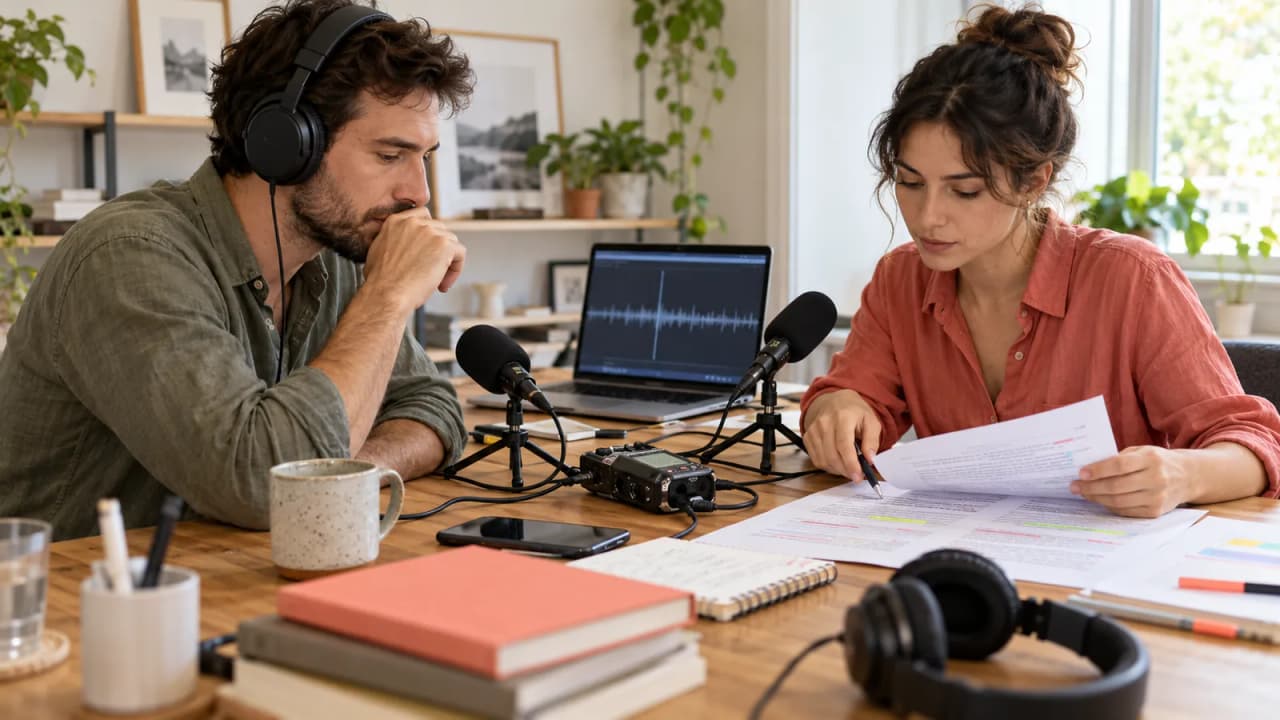
Before publishing interview quotes found through ChatGPT audio uploads, listen to the original passage, identify the speaker, and check the surrounding exchange. A transcript can help you find material; it should not be the final authority on what someone said.
Picture a creator turning a studio interview into a short article. A summary makes a hesitant observation sound like a firm endorsement. The edit reads smoothly, but the stronger sentence is not supported. The fix starts with a quote review sheet before a script.
OpenAI's October 6 release note introduced audio uploads for transcripts, summaries, and questions about recordings. This October 15 workflow uses that recent update as context; it does not describe a launch today or present results from a Growit transcription test.
Put a filled review sheet beside the recording
This example is fictional. The candidate note is a paraphrase for planning, not a quotation attributed to a real interviewee.
| Review field | Filled example |
|---|---|
| Source file | studio-interview-original.m4a, retained unchanged in the private project folder. |
| Intended piece | A profile about a ceramicist's process for choosing glaze colors. |
| Candidate note | Paraphrase: the artist compares test tiles in daylight before choosing a glaze. |
| Passage reference | The discussion after the question about color selection; exact boundaries still need listening review. |
| Exact quote field | Empty until the editor checks the recording word for word. |
| Speaker and permission | Artist identified in the source notes; confirm permission for the selected public excerpt. |
| Use decision | Hold the quotation; use the candidate note only to locate the passage. |
The empty quote field is deliberate. A complete working sheet can accurately record an unresolved check. Filling it with polished language would hide the very problem the review needs to solve.
Confirm the source and upload conditions
OpenAI's file and audio upload guide lists audio uploads for paid subscriptions and workspaces, with availability depending on account settings, region, client, and model. It supports formats including WAV, MP3, and M4A. Check your current account before relying on the feature.
Use a recording you are permitted to process for this purpose. An agreement to participate in a conversation does not automatically answer every editorial question about a public clip or a third-party upload. Check the actual agreement and ask the source when the intended use is unclear.
Keep an untouched original. If you remove irrelevant private material or make a shorter working excerpt, label that copy and retain enough surrounding context for the editor to understand the exchange. Record any offset between the excerpt and the original.
Ask for candidate passages, not finished testimony
Give the assistant a narrow retrieval job: “Find passages relevant to how the artist chooses glaze colors. For each, give a brief paraphrase, a location if available, the question being answered, and any uncertainty about wording or speaker. Do not turn a summary into a direct quote.”
Keep that instruction with the output. A useful candidate list should lead you back to the recording. If locations are approximate or absent, use topic landmarks and listen manually. Do not present a suggested timestamp as verified just because it looks precise.
Separate the tasks. First locate material. Next verify it. Only then draft the article or clip. Asking for a finished profile immediately encourages the writer to build a narrative before the evidence has been checked.
Listen through the boundaries of the answer
OpenAI warns that transcripts can contain errors and speaker identification may be unreliable. Review important details against the original recording rather than trusting the cleanest sentence in the transcript.
Listen from the question through the end of the answer. Check names, numbers, negation, and qualifications. A missed “not” or a dropped “in this test” can change the meaning. Where people overlap, do not guess who supplied the decisive phrase.
Write down what remains unclear. Replay a difficult passage at a useful speed, compare another recording if one exists, or ask the speaker for clarification. If you still cannot hear the words confidently, choose another passage. An uncertain line does not become reliable through repeated rewriting.
Keep quotations, paraphrases, and summaries distinct
Put only verified wording inside quotation marks. Preserve the meaning and context when making any editorial cut, and follow the standards of the publication or project receiving the piece. If a change needs explanation, make that explanation visible to the reviewer.
A paraphrase is your wording of a specific idea. A summary compresses a larger discussion. Label both in the working document so a later editor does not mistake a useful note for recorded speech. Retain the source reference even when the final article uses no direct quotation.
In the fictional example, the candidate about daylight remains a lead until the recording supports it. After verification, the creator might write an accurate paraphrase or choose a short exact excerpt. Neither option should expand a personal working preference into a universal claim about ceramics.
Build the public artifact from checked rows
Create the draft from passages whose review is complete. Attach each important sentence to the relevant source location and record who checked it. Keep unresolved material in a separate working note instead of allowing it to drift into the public script.
For a clip, review the actual start and end points. A speaker may qualify a statement just after the proposed cut. For an article, check the headline and introduction too: accurate quotations can still sit beneath an unsupported overall promise.
Share only the material the reviewer needs. The full interview may contain unrelated personal details, discarded ideas, or comments outside the planned piece. A private source folder and a clean review excerpt serve different purposes.
Finish one verified passage before expanding
Choose one candidate, listen back, complete the sheet, and produce one checked paragraph or clip. Resolve that small handoff before asking AI to build a full series from the interview.
If your current Growit account and platform provide a suitable planning workflow, adapt the sheet through o1 guides and the o1 workspace. ChatGPT's audio feature does not establish an o1 integration, live call, or background transcription capability. The physical o1 device remains in development; see o1 specifications for current product scope.
Keep the recording available until the publication review is finished. The useful endpoint is an excerpt another editor can trace to its source and understand in context.